
 Let’s Talk
- By Pet-Tek Australia
- September 4, 2026
- No Comments
Are Pet Doors a Security Risk?
Home › Guides › Choosing a Pet Door › Are Pet Doors a Security Risk?
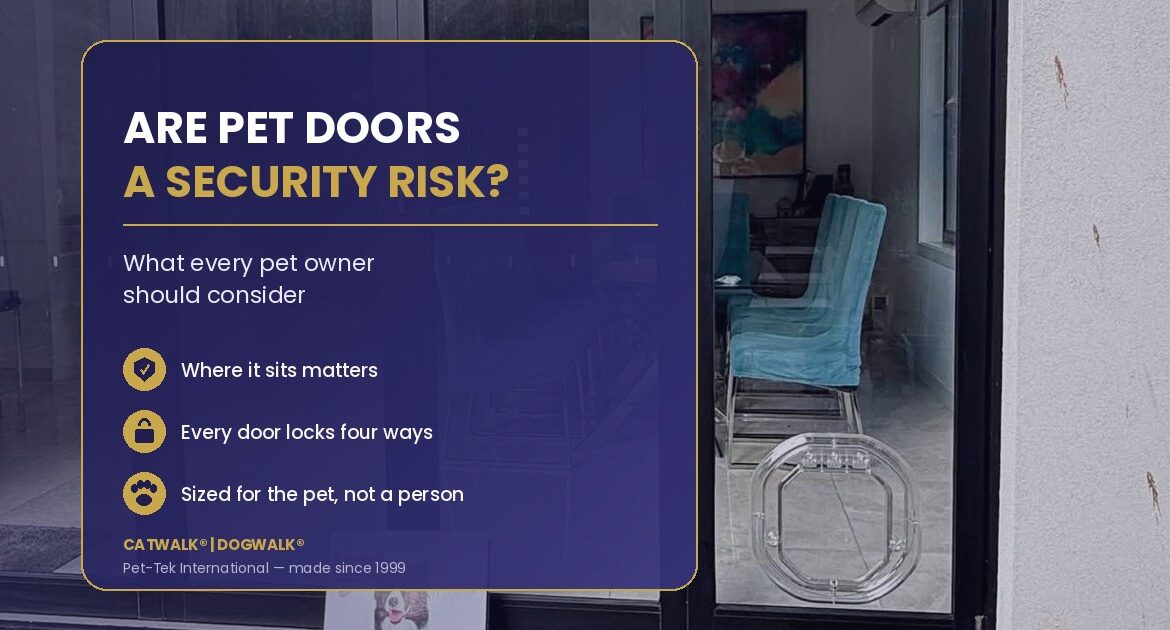
Are Pet Doors a Security Risk?
Pet door security comes down to two things, and the size of the flap is not really either of them. A cat door is not a security risk — the opening is smaller than a sheet of A4 and no adult is going through it. A large dog door deserves a bit of thought, not because someone will crawl through, but because of where it sits in relation to your locks. Both have straightforward answers, and neither is a reason to go without.
This question stops more people from buying a pet door than any other, and most of what is written about pet door security online is either scaremongering from alarm companies or hand-waving from retailers. We make the doors, so here is the useful version.
Start with the actual size of the hole
Almost every worry about pet door security evaporates once you look at real dimensions rather than imagined ones. These are the flap openings across the range.
| Door | Flap opening (W × H) | Roughly |
|---|---|---|
| Original cat door | 165 × 193 mm | Smaller than an A4 sheet |
| Slim line cat door (timber) | 155 × 170 mm | Smaller again |
| Slimline pet door | 187 × 203 mm | About a shoebox end |
| Intermediate dog door | 216 × 250 mm | About an A4 sheet |
| Dog door — medium to semi-large dogs | 270 × 313 mm | A bit larger than A4 |
| Timber dog door | 270 × 320 mm | The tallest in the range |
Hold a sheet of A4 paper up in front of you. That is the size of the largest opening we make. It is not a route into a house for an adult, and it never has been.
Worth comparing the openings side by side if you are still choosing — the full range is in cat doors and dog doors.
The number that matters is the flap, not the frame. People sometimes look at the overall unit — 415 × 430 mm on the biggest glass model — and picture that as the hole. It isn't. The frame clamps to the glass; only the flap opening is a way through, and that is 270 × 313 mm.
What pet door security actually depends on
Two things, and neither is the size of the opening. Get both right and pet door security stops being a question worth losing sleep over.
1 · Where the door sits in relation to your locks
This is the real consideration and it applies to every pet door regardless of size. An opening positioned within arm's reach of a door handle, a snib, a deadlock thumbturn or a window latch is a weaker installation than the same opening placed away from them. It costs nothing to get right — it is purely a question of where you put it on the day.
The rule of thumb every good installer already follows: site it low, and on the hinge side, away from the handle and the lock. On a sliding door, put it in the fixed panel rather than the sliding one. If you are using a timber door, a laundry or garage door is often better than the main back door for exactly this reason — and that is what the wood fitting cat doors and wood fitting dog doors are built for.
It is worth saying plainly to whoever fits it. Most glaziers will place it sensibly by default, but "as far from the lock as the glass allows" is a sentence worth using when you book the job.
2 · Whether the door can be locked at all
A flap that only swings is a flap that is always open. Every Catwalk and Dogwalk door has a four-way lock built in as standard — not sold as an upgrade — with four settings on a single dial.
| Setting | What it does | When it earns its keep |
|---|---|---|
| Fully open | Swings both ways | Normal daytime use |
| In only | Pet can come home, not go out | Overnight |
| Out only | Pet can leave, not return | Before a vet appointment |
| Locked | Sealed shut | Away from the house, or at night |
Set it to locked when you go away and the opening is closed. That single dial answers most of what people mean when they ask whether pet doors are safe. It is fitted to every model we make — glass fitting cat doors, glass fitting dog doors, and the wood fitting range alike.
Glass doors: does cutting the pane weaken it?
A fair question, and one where pet door security depends on how the job is done rather than on the door itself.
A glass fitting pet door does not sit in a hole with raw edges exposed. The two halves of the unit clamp around the pane and seal against it on both faces, so the cut edge is enclosed by the frame. Done by a glazier, the pane is no more fragile in ordinary use than before.
Where it matters is toughened glass, which is common in Australian sliding doors. Toughened glass cannot be cut after it has been toughened — it shatters. So a competent glazier does not cut your existing toughened pane at all. They order a replacement pane that is cut and drilled first and then toughened, and swap it in. You end up with a pane that is still fully toughened, still meets its safety standard, and has the opening built into it.
If anyone offers to cut your toughened pane in place, stop. It cannot be done safely and it is a sign the person quoting does not work with toughened glass regularly. Look for the small etched stamp in a bottom corner of the pane — that is how you know what you have, and it is worth photographing and sending with your quote request. More on how installation actually works →
Security screens are the one to think about properly
If your back door has a certified security screen, that screen is the security layer — not the glass behind it, and not the pet door. Its mesh, frame and retention system are engineered to work together, and cutting into the mesh releases its tension and undermines the whole assembly. That is a genuine security question, and it is different from the pet door question.
It has good answers. A screen can be manufactured with the pet door already built into it, so nothing is cut after certification. An aperture can be properly formed in a non-certified screen or flywire. Or the pet door can go somewhere the screen does not cover at all.
The full guide to pet doors and security screens covers all three routes →
What about pets other than yours coming in?
In practice this is the pet door security problem people actually experience — not intruders, but the neighbour's cat, or a possum. A standard flap cannot tell one animal from another; it opens for whatever pushes it.
The four-way lock is most of the answer. Set to in-only after your animal is home for the evening and nothing new is getting in. There is more to it than the dial, though, and we have written that up separately.
How to stop other cats coming through a cat door →
A short checklist for pet door security
- Choose the smallest flap your animal is genuinely comfortable with. Measure across the shoulders at the widest point and go a comfortable margin wider — not more. Our sizing guide walks through it.
- Site it away from handles, snibs, deadlocks and window latches. Say this to the installer when you book.
- On a slider, use the fixed panel rather than the moving one.
- Consider a laundry or garage door instead of the main back door. Often cheaper to fit, and it keeps the opening away from your primary entry.
- Use the lock. Locked when you are away, in-only overnight. It is built in — it costs nothing to use it.
- If there is a security screen, plan it into the job from the start, not after the glass is already cut.
- Check your home and contents policy if you want certainty about how yours treats external modifications. Policies differ and only your own insurer can tell you what yours says.
The honest summary
A cat door is not a way into a house. A dog door is not either, at the sizes anyone actually fits. Pet door security is decided by where the opening is placed and whether it can be shut — both settled on the day it goes in, both costing nothing, and both entirely within your control.
If you are still unsure, tell us what door you are working with and we will tell you where we would put it. Or start from the range — cat doors, dog doors and spare parts.
Find the right door Ask us directly
Common questions
Can a person fit through a dog door?
Not through the sizes fitted in Australian homes. The largest flap opening we make is 270 × 320 mm — a little larger than a sheet of A4 held up in front of you. The relevant security question is not the size of the opening but where it sits relative to your locks, which is why siting it away from handles and latches is the advice that matters.
Do all pet doors lock?
Ours do. Every Catwalk and Dogwalk door has a four-way lock built in as standard rather than sold as an accessory — fully open, in only, out only, or locked shut. Not every brand includes one, so it is worth checking before you buy from anyone.
Does cutting a hole in glass make the door weaker?
Not in ordinary use, when a glazier does it. The two halves of the unit clamp around the pane and seal on both faces, so the cut edge is enclosed within the frame rather than exposed. With toughened glass the pane is not cut at all — a replacement is manufactured with the opening already formed and then toughened, so it still meets its safety standard.
Where is the safest place to put a pet door?
Low, on the hinge side, and as far from the handle, snib or deadlock as the door allows. On a sliding door, the fixed panel rather than the sliding one. A laundry or garage door that opens onto the yard is often the best answer of all — it keeps the opening away from your main entry and is usually cheaper to fit, particularly if it is timber.
Can a pet door go in a security screen?
Not by cutting a certified one — its mesh, frame and retention system are engineered as a single assembly and cutting the mesh undermines the rest. The workable routes are a screen manufactured with the pet door already built in, an aperture formed properly in a non-certified screen or flywire, or siting the pet door where the screen does not reach. The security screens guide covers all three.
Will my insurance be affected?
That depends entirely on your policy, and only your insurer can tell you. Home and contents policies vary in how they treat modifications to external doors and windows, so if you want certainty, ring them or read your product disclosure statement before the work is booked. We cannot tell you what your policy says and would not try.
What stops other animals getting in?
The four-way lock, mostly. A standard flap cannot distinguish one animal from another, so the practical control is when the door is open rather than who can push it. Set it to in-only once your pet is home for the evening. If a neighbourhood cat or a possum has already started coming in, there is more to it than the dial — we have written that up separately.
What makes a pet door secure?
Three things, in order: where it sits, whether it locks, and how big it is. Pet door security is mostly a placement decision — an opening away from handles, snibs and deadlocks is a stronger installation than the same opening beside them. Then the four-way lock, used rather than ignored. Size comes last, because at the sizes actually fitted in Australian homes it is not the deciding factor.
Is a smaller flap more secure?
Marginally, but it is not the deciding factor and it should never override fitting your animal properly. A pet that has to force itself through a flap will simply stop using the door, and then you are back to leaving the real door open — which is genuinely less secure than any pet door. Size it for the animal, then place it and lock it sensibly.
Written by Pet-Tek International, who have manufactured Catwalk® cat doors and Dogwalk® dog doors since 1999. We make the doors described here, which is a bias worth knowing about — so this article names what we cannot do as well as what we can.