
 Let’s Talk
- By Pet-Tek Australia
- September 9, 2026
- No Comments
What Size Cat Door Do I Need?
Home › Guides › Choosing a Pet Door › What Size Cat Door Do I Need?
What Size Cat Door Do I Need?
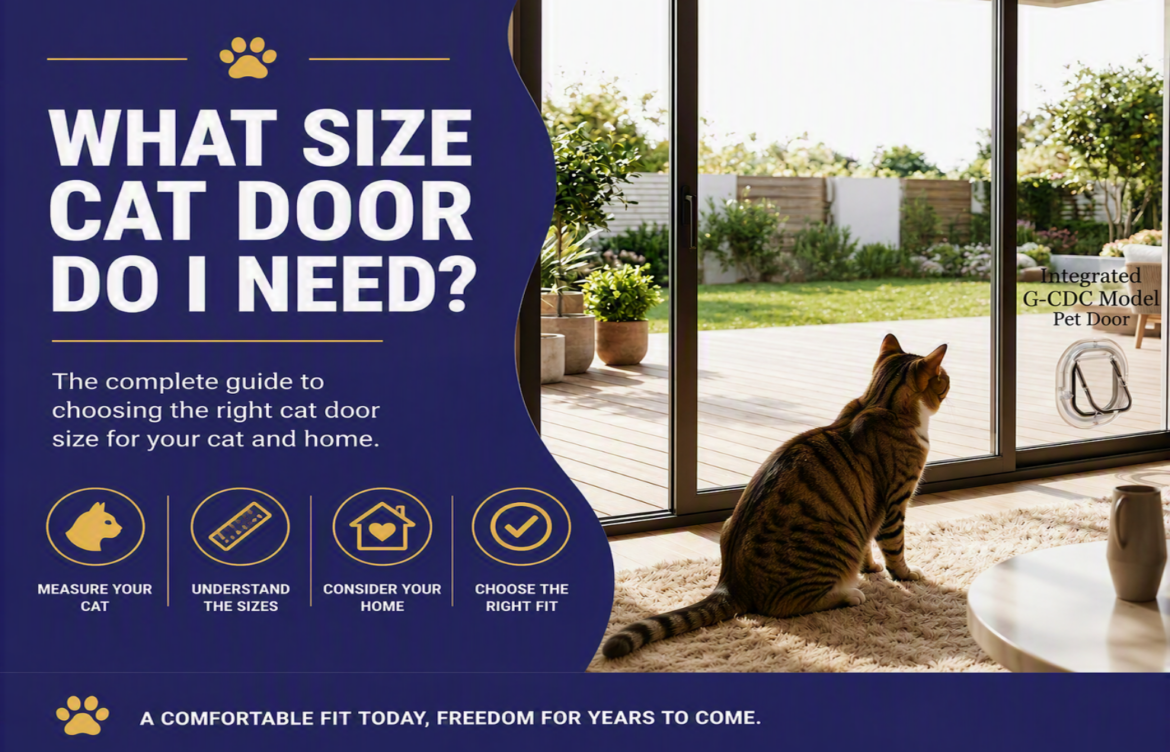
Most cats fit the standard flap without any drama — but "most" is not "all", and the ones that don't are usually the big, broad-chested breeds people assume will be fine. Three measurements take five minutes and settle it. This guide walks through them, then matches the numbers to a model.
Cat doors are simpler than dog doors: there are fewer sizes and the range of cats is narrower. What trips people up is not the flap size — it's the installation height. A flap fitted too high is the single most common reason a cat refuses to use a door that fits perfectly well.
Three measurements, five minutes
1Widest point across the body
Measure across the widest part of your cat — usually the chest, just behind the front legs. On a heavier cat it can be the belly. Measure both and use the larger figure. This is the number that decides whether a flap is wide enough, and it is the one people skip.
2Shoulder height
Stand your cat square on a flat floor and measure from the ground to the top of the shoulder blades. Not the top of the head — cats lower their head as they step through, so they don't need clearance for their ears.
3Belly height from the ground
Measure from the floor to the bottom of the chest, at the lowest point. On most cats this comes out between 100 and 150 mm. This figure does not choose your model — it sets your installation height, which is the section further down and matters more than anything else on this page.
Kittens: size for the adult cat, not the kitten in front of you. A slightly oversized flap costs nothing; re-cutting a glass panel a year later costs a glazier's visit.
Two cats: size for the larger one. The smaller cat will use a bigger flap without complaint. The reverse is not true.
The cat doors in the range, and who they suit
All four cat models share one thing: the closing action is deliberately light. A stiffer flap would seal better against wind, but a cat that has to shove hard simply stops using the door — so the force is calibrated for the cat, not the weather.
| Model | Fits into | Flap panel (W × H) | Best for |
|---|---|---|---|
| W-CDW / W-CDB Slim line cat door, timber | Timber, PVC, steel or metal panels 11–30 mm thick | 155 × 170 mm | The default. Suits the great majority of domestic cats. |
| W-CDTW / W-CDTB Cat door with tunnel, timber | Thicker panels, 11–52 mm — the self-lining tunnel adjusts, no cutting | 155 × 170 mm | Solid-core doors, garage doors, thick weatherboard. |
| W-MCDW Multi-magnetic cat door, timber | Panels 11–52 mm thick | 155 × 170 mm | Selective entry — locked by default, opens only for a cat wearing the C-M collar magnet. |
| G-CDC / G-CDW Original cat door, glass | A glazier-cut hole in a glass panel | 165 × 193 mm | Glass doors and windows. The largest cat flap in the range. |
| G-SDDC / W / B Maxi pet door, glass | A glazier-cut hole in a glass panel | 187 × 203 mm | The step up for a very large cat — Maine Coon, big Ragdoll, large Bengal. |
See all cat doorsFind Your Fit tool
A rough guide by breed
Breed is a starting point, not an answer — a well-fed domestic shorthair can be wider than a lean Bengal. Measure before you order. That said:
| Cat | Typical adult weight | Start with |
|---|---|---|
| Domestic shorthair / moggy | 3.5–5.5 kg | W-CDW slim line, or G-CDC in glass |
| Burmese, Siamese, Abyssinian | 3–5 kg | W-CDW slim line, or G-CDC in glass |
| Russian Blue, Devon Rex, Tonkinese | 3–5 kg | W-CDW slim line, or G-CDC in glass |
| British Shorthair | 4–8 kg | W-CDW usually fits; G-CDC in glass — broad build, measure the width |
| Bengal | 4.5–7 kg | G-CDC in glass, or W-CDW in timber — long-bodied but lean |
| Ragdoll | 5–9 kg | G-CDC in glass. A large male may need the G-SDD maxi — measure |
| Norwegian Forest Cat | 5–9 kg | G-CDC in glass. Large males: measure first |
| Maine Coon | 6–11 kg | Measure first. Many need the G-SDD maxi rather than a cat flap |
| Overweight cat of any breed | — | Measure the belly at its widest. Weight alone tells you nothing useful |
Installation height — the part that decides whether it gets used
This is where most cat doors go wrong, and it has nothing to do with the flap size.
The bottom of the opening should sit level with your cat's belly — the measurement you took in step three, usually 100 to 150 mm from the floor. Cut it there and your cat steps through. Cut it higher and your cat has to jump into the flap, land on the far side, and repeat that dozens of times a day. Cats simply won't.
Two practical points:
- Measure from the finished floor level on the outside as well. A deck or path 80 mm below the inside floor changes the step-over height on one side only.
- Sizing for two pets? Size the flap for the biggest, but set the height for the smallest. A bigger cat can duck; a small one can't grow legs.
Timber or glass — where it's going narrows the field
The panel you're cutting into decides the model as much as the cat does.
- A timber, PVC or metal door. W-CDW if the panel is 11–30 mm; W-CDTW if it's thicker, up to 52 mm. You can fit either yourself with the cutting template supplied.
- A glass door or window. G-CDC or G-CDW. The glass has to be cut by a glazier — toughened glass cannot be drilled or cut after manufacture, so a toughened panel is replaced with a new one made with the hole in it. Our guide to double glazing and toughened glass covers what that involves, and what it costs is set out here.
- A security screen. Read this first — screens need the door fitted into the screen frame, not through it.
If your pet is closer to a small dog than a cat, our dog door sizing guide picks up where this one stops.
If other cats are already coming through an existing flap, the size isn't the problem — the multi-magnetic door is the answer to that one.
Find an installerSend us your measurements
Common questions
What size cat door do I need for a normal-sized cat?
The W-CDW slim line cat door, with a 155 mm wide flap, fits the great majority of Australian domestic cats. In a glass panel the equivalent is the G-CDC original cat door, which is slightly larger at 165 mm wide. If your cat is under about 6 kg and not unusually broad, either will fit comfortably.
How do I measure my cat for a cat door?
Three measurements. First, the widest point across the body — usually the chest just behind the front legs, sometimes the belly on a heavier cat. Second, shoulder height, floor to the top of the shoulder blades. Third, the height from the floor to the bottom of the chest, which sets where the opening is cut. The opening should be at least 25 mm wider than the widest point, with its top edge at least 25 mm above shoulder height.
What size cat door for a Maine Coon?
Measure before ordering. Maine Coons run from 6 to 11 kg and many are too broad for a standard cat flap. A large one usually needs the G-SDD maxi pet door, with a 187 mm wide flap, rather than a cat door. Send us the widest measurement across the chest and we will tell you which one fits.
How high off the floor should a cat door be installed?
The bottom of the opening should sit level with your cat's belly — for most cats between 100 and 150 mm above the floor. This is the most common installation mistake. A flap set too high forces the cat to jump into it, and cats stop using doors that require that. Check the floor level on both sides: a deck or path lower than the inside floor changes the step-over height on the outside only.
Can a small dog use a cat door?
Sometimes. A Chihuahua, a Maltese or a Pomeranian will often fit a cat flap. A Pug or a French Bulldog usually will not, because they are broad through the chest even though they are short. Measure the widest point rather than going on the dog's height, and see our dog door sizing guide if you are between the two ranges.
Do I need a bigger cat door if I have two cats?
Size the flap for the larger cat and set the installation height for the smaller one. A big cat will duck under a low opening without complaint; a small cat cannot reach a high one. Both cats can share the same door — there is no need to fit two.
What is the difference between the cat door and the cat door with tunnel?
Only the panel thickness they suit. The W-CDW slim line fits panels 11 to 30 mm thick. The W-CDTW tunnel version fits 11 to 52 mm and has a self-lining tunnel that adjusts to your panel depth without any cutting. The flap, the size and the way the cat uses it are identical.
Will a cat door fit in double glazing?
Yes, but the sealed unit has to be replaced with a new one manufactured with the hole already in it — a double-glazed unit cannot be cut once it is made, and neither can toughened glass. A glazier measures the panel, orders the replacement unit, and fits the door into it. Our guide to double glazing and toughened glass explains the process and what to expect.
What if my cat still won't use the door after I fit it?
Nine times out of ten it is the height, not the size. Check that the bottom of the opening is level with your cat's belly and that the cat is not having to jump. If the height is right, tape the flap open for a few days so the cat learns the route before it has to push anything, then let it down.
Pet-Tek International has manufactured Catwalk® cat doors and Dogwalk® dog doors since 1999. If you are between two sizes, send us your cat's measurements and we will tell you which door fits — including when the answer is that none of them do.