
 Let’s Talk
- By Pet-Tek Australia
- September 2, 2026
- No Comments
Can You Put a Cat Door in Double Glazing or Toughened Glass?
Home › Guides › Installation & Fitting › Cat Door in Double Glazing or Toughened Glass
Can You Put a Cat Door in Double Glazing or Toughened Glass?
Yes to both — but not into the glass you already have. Cat door double glazing jobs and toughened glass jobs end the same way: a new panel or unit, manufactured with the pet door hole already cut. Toughened glass cannot be drilled once it has been made, and a sealed double-glazed unit cannot be opened and resealed on site. The door itself is the easy part.
This catches out more Australian homeowners than any other pet door question, largely because it sounds like it ought to be a drilling job. It isn't. Here's what's actually going on, and what each route costs.
Toughened glass: why drilling isn't an option
Toughening — tempering — is a heat treatment. The glass is taken to around 620 °C and then chilled fast. The surfaces cool and set first, the core cools afterwards and pulls inward, and the finished panel ends up with its faces in compression and its centre in tension. That's what makes it four to five times stronger than ordinary glass, and it's what makes it crumble into blunt granules instead of shards when it does break.
It's also permanent. Introduce a hole, a cut, or even a deep scratch on the edge, and the stored tension releases all at once. The panel doesn't crack — it disintegrates. There is no drill bit, no water-jet setting and no glazier's technique that changes this.
How to tell what you've got
| Clue | What it means |
|---|---|
| A small etched or sandblasted stamp in a bottom corner, naming a standard or maker | Toughened. The stamp is mandatory on safety glass in Australia. |
| No stamp anywhere on the panel | Probably annealed float glass — drillable, but have a glazier confirm |
| Two panes with a visible metal spacer bar around the perimeter | Double glazed — an insulated glass unit (IGU) |
| Pre-1990s house, fixed window, small pane | Often annealed |
| Any door, sidelight, or glazing below about 500 mm from the floor | Almost certainly toughened — Australian standards require it |
If it turns out your glass is annealed, the job gets much cheaper — a glazier can core-drill it in place. We break the full cost picture down in what it costs to install a pet door in glass in Australia.
Double glazing: a different problem entirely
A double-glazed unit is two panes separated by a spacer bar, sealed around the edge, with dry air or argon in the cavity. Everything about how it performs depends on that seal staying intact.
Putting a cat door through one means the spacer has to run around the pet door opening as well as the perimeter, and the whole cavity has to be resealed. That's fabrication work, not site work. What happens in practice is that the fabricator makes a new unit with the aperture built in from the start.
Some glaziers will instead suggest replacing just that unit with a single toughened sheet at the pet door location. It's cheaper. It also throws away the thermal performance you paid for on that panel — so it's worth deciding deliberately rather than by default, particularly on a south-facing or heavily exposed elevation.
| Approach | Cost in Australia | Thermal result |
|---|---|---|
| New double-glazed unit with the aperture built in | $800 – $1,400 | Retained |
| Replace the unit with a single toughened pane | $450 – $800 | Lost on that panel |
| Move to an adjacent single-glazed window or door instead | $400 – $750 | Untouched |
| Through the wall beside the window with a tunnel model | $150 – $400 | Untouched |
That last row is the one most people never consider, and it's frequently the best answer. We cover the same trade-off for sliding doors in dog doors for sliding glass doors.
Which cat door for which glass
Glass thickness is the deciding factor, and the ranges differ more than people expect. A door rated to 10 mm will not fit a 24 mm insulated unit.
| Model | Glass thickness | Cut-out | Flap (W × H) | Best for |
|---|---|---|---|---|
| G-CDW / G-CDC original | 3 – 10 mm | 245 mm dia | 165 × 193 mm | Standard single glazing |
| G-SDDSLC / G-SDDSLW maxi slim | 3 – 21 mm | 267 mm dia | 187 × 203 mm | Larger cats; thicker single glazing |
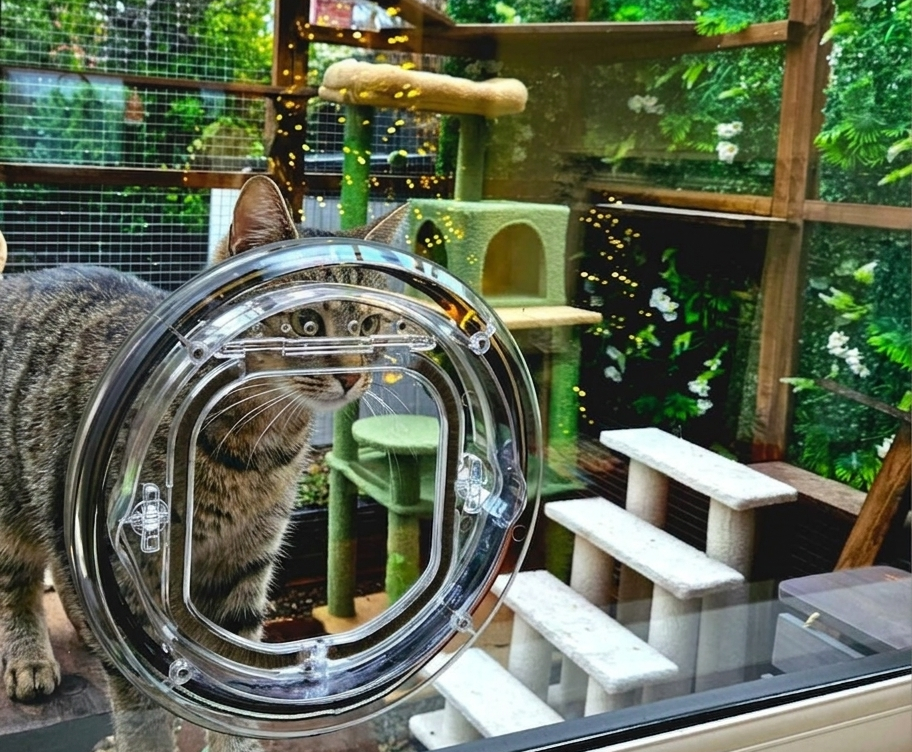
| G-SDDC / G-SDDW / G-SDDB maxi dual glaze | 3 – 28 mm | 267 mm dia | 187 × 203 mm | Double glazing — the widest glass range at cat size |
For a genuine double-glazed unit, the maxi dual-glaze models are the ones to specify. At up to 28 mm they cover the great majority of Australian residential IGUs. If your unit measures thicker than 28 mm overall, the intermediate dual glaze range takes 4–32 mm — though its flap is dog-sized, so it's only worth considering if a larger opening suits the household.
Not sure which one your glass needs? The Find Your Fit tool asks four questions and returns the exact cut-out figure to hand to your glazier.
See the glass fitting cat door range
Ordering the glass without getting it wrong
The cut-out diameter has to be correct before the panel is toughened, because there is no fixing it afterwards. Get it wrong and you buy the panel twice. Our cut-out sizes and trade specifications page sets out every model’s figures in one place. Give the glazier this, in writing:
- The model code — for example G-SDDC
- The cut-out diameter — 267 mm
- The glass thickness range the door accepts — 3 to 28 mm
- Where the centre of the hole sits, measured from two fixed edges of the panel
- Whether the panel is single, toughened, laminated or double glazed
On height: the bottom of the flap should sit roughly 100–150 mm above floor or ground level on the outside for a cat. Too low and you catch rain runoff and leaf litter; too high and older cats stop using it.
Any qualified glazier can fit a Catwalk door — there is nothing proprietary about the installation. Our installer directory lists independent fitters across Victoria, NSW, Queensland and WA if you'd rather start with someone who has done it before.
If the glass route is too expensive
Before committing to new glass, look elsewhere in the house. Two alternatives cost a fraction of a glazing job:
- A timber, uPVC or metal door. A wood fitting cat door is a DIY job with a jigsaw and the supplied template, so you pay for the unit only.
- Through the wall beside the window. The W-CDTW and W-CDTB tunnel models handle 11 mm to 52 mm of wall or panel thickness, which covers most single-brick and stud-wall situations. Thicker walls need an extension.
Neither touches your glazing, and both leave the thermal performance of a double-glazed window exactly as it is.
Common questions
Can you cut a hole in toughened glass for a cat door?
No. Toughened glass shatters completely if drilled or cut after manufacture. The panel must be replaced with one that had the hole cut before it went through the toughening furnace.
Can you put a cat flap in double glazing?
Yes, but the double-glazed unit has to be remade with the aperture included. It can't be opened and resealed on site.
How do I know if my glass is toughened?
Look for a small etched stamp in a bottom corner — it's mandatory on Australian safety glass. No stamp usually means annealed float glass, but have a glazier confirm before anyone drills anything.
Does a cat door in double glazing cause condensation?
Not if the unit was fabricated properly. Condensation inside a double-glazed unit means the perimeter seal has failed, which is a fabrication or handling issue rather than something the pet door causes.
What is the cheapest way to get a cat door if my glass is toughened?
Look elsewhere in the house first. A timber, uPVC or metal door takes a wood fitting cat door as a DIY job for the price of the unit. Going through an adjacent wall with a tunnel model is the next cheapest. Replacing glass is the most expensive path.
How thick a wall can a tunnel cat door go through?
The W-CDTW and W-CDTB tunnel models handle 11 mm to 52 mm. Thicker walls need an extension.