
 Let’s Talk
Pet Doors and Security Screens: The Australian Guide
Home › Guides › Choosing a Pet Door › Pet Doors and Security Screens
Pet Doors and Security Screens: The Australian Guide
If your back door has a screen — and in most Australian homes it does — pet doors and security screens have to be solved together. Fitting a pet door in the glass and forgetting the screen leaves your animal facing a mesh wall. The workable answers are a purpose-made screen with the pet door built in, a properly retrofitted aperture in the existing screen, or a route that bypasses the screen entirely.
This is the single most-overlooked step in Australian pet door installations, and it's usually discovered after the glass has already been paid for.
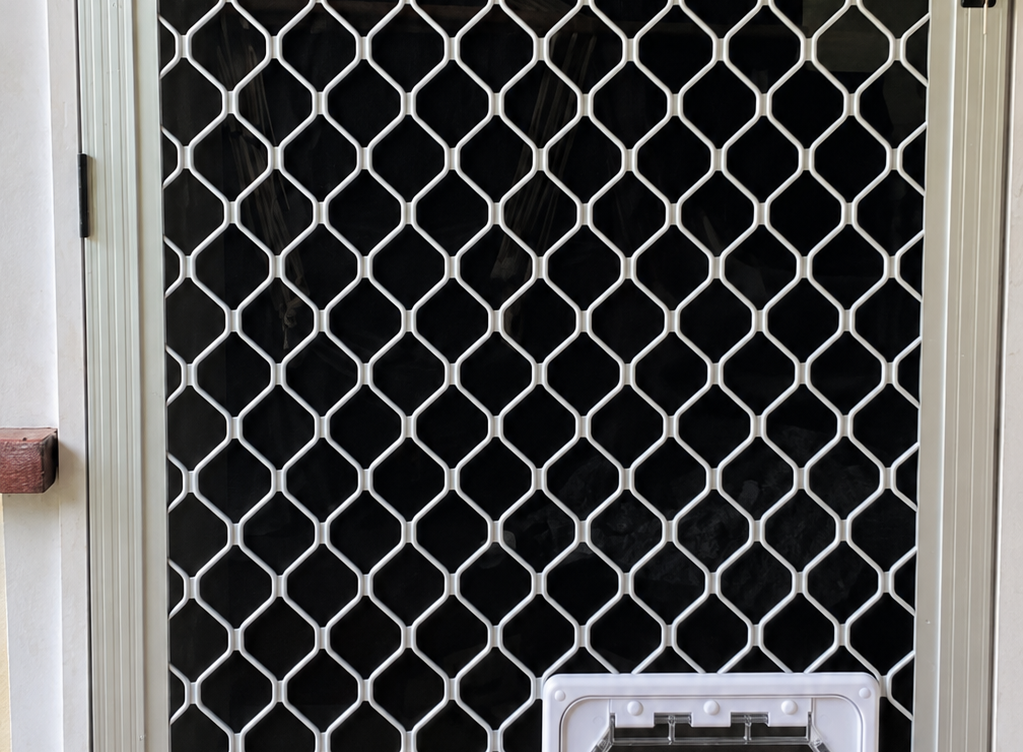
The photo above shows one solution: a W-DDW wood fitting dog door retrofitted into a diamond-grille screen door, sited low and on the hinge side, well away from the handle and lock. That siting is deliberate, and worth copying.
Which range goes into a screen
Worth settling first, because it decides who you call. A screen aperture usually takes a flat-panel body — the wood fitting range — because wood fitting doors mount through a panel, and a screen is a panel. Glass fitting doors are built to clamp around a pane instead, though some screen installers do retrofit them. Ask your installer which they work with before you order anything.
The relevant fitting ranges:
| Model | Flap (W × H) | Fits panels | Suits |
|---|---|---|---|
| W-CDW / W-CDB slim line cat door | 155 × 170 mm | 11–30 mm | Cats, very small dogs |
| W-SDDW / W-SDDB small dog door | 180 × 240 mm | 11–30 mm | Small dogs |
| W-DDW / W-DDB timber dog door | 270 × 320 mm | 5–36 mm | Medium to large dogs — tallest flap in the range |
| W-CDTW / W-SDDTW tunnel models | 155 × 170 · 180 × 240 mm | 11–52 mm | Thicker panels and walls |
Sizing works the same way as any other installation — measure the animal first, then pick from the published range.
Why a certified screen can't just be cut
A genuine security screen isn't flywire. It's a stainless steel or structural aluminium mesh, tensioned into the frame and held by a retention system designed to resist knife shear and jemmy attack. Frame, mesh and retention work as one system.
Cut a hole in it and three things happen: the mesh loses tension across the panel, the retained edge is interrupted at the cut, and the screen no longer matches the specification it was certified to.
The four options
1. A new screen with the pet door built in
The screen manufacturer builds the aperture into the frame during fabrication, with the mesh properly terminated and retained around it. Structural integrity and certification are maintained.
- Cost: $600 – $1,400 for the screen, plus the pet door unit
- Best when: the screen is old, or the pet door coincides with a screen upgrade
- Downside: you're replacing a working screen
2. Retrofit into the existing screen
A screen specialist cuts the aperture, adds a reinforcing sub-frame, re-terminates the mesh and fits the pet door — the installation shown in the photo above. Done properly this is a legitimate solution. Done with a jigsaw and optimism, it isn't.
- Cost: $250 – $500 plus the unit
- Best when: the screen is in good condition and the manufacturer offers a retrofit service
- Downside: on a certified screen this will usually affect the warranty and the certification
3. Bypass the screen entirely
Often the smartest answer, and the one people forget. If there's a wall, a laundry door, a garage door or a fixed side panel near the main opening, put the pet door there and leave the screen alone.
- Cost: the unit only, from about $55, DIY with the supplied template
- Best when: any suitable alternative surface exists
- Downside: the pet door isn't where you first pictured it
4. Screen and glass, both done
The complete solution: a pet door in the glass and an aligned aperture in the screen, so the animal walks straight through both.
- Cost: $900 – $1,800 all up
- Best when: the main sliding door is genuinely the only viable route
- Critical: both apertures must line up — see the next section
| Option | Cost | Effect on a certified screen | Reversible |
|---|---|---|---|
| New screen with built-in pet door | $600 – $1,400 | Maintained | No |
| Retrofit into existing screen | $250 – $500 | Usually affected | No |
| Bypass — wall, side door or laundry | From $55 | Untouched | Partly |
| Screen and glass together | $900 – $1,800 | Depends on method | No |
Getting the alignment right
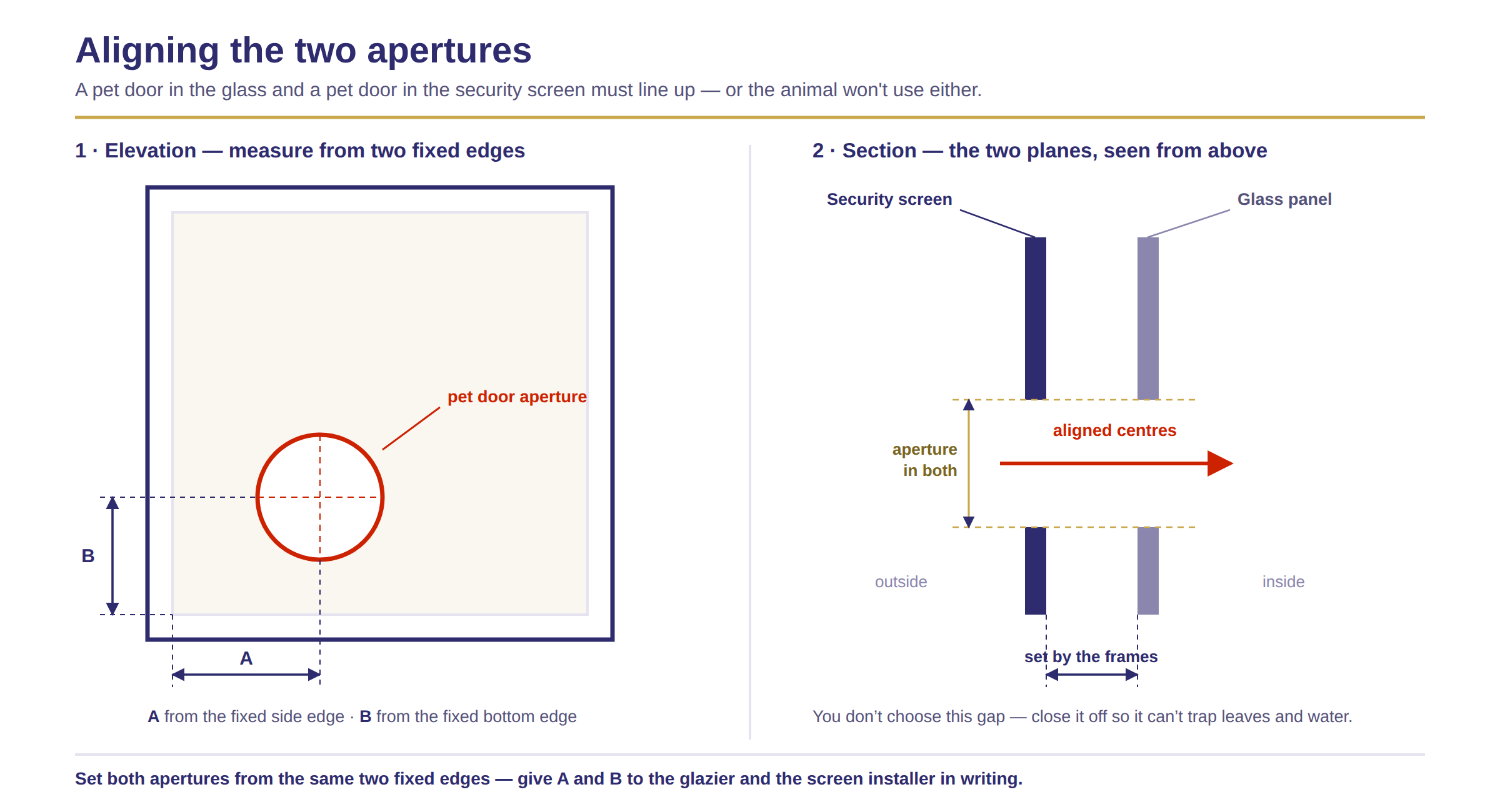
When both barriers get a pet door, alignment is everything. An animal won't reliably navigate two apertures that don't line up, and an open cavity between them collects leaves, water and insects.
- Decide the model and the installation height first — before either trade quotes.
- Set the centre point as a measurement from two fixed edges, and give the identical figures to both trades in writing.
- Have the glass done first. Glass has a lead time; the screen doesn't.
- Close off the space between the two apertures. You don't choose that gap — it's set by how the screen and the door are built — but an open cavity between them collects leaves and water.
- Check for a level, non-slip surface on the outside. An animal stepping out onto slippery tiles will hesitate.
If the glass side of the job is new to you, what it costs breaks the pricing down, and toughened or double-glazed panels are a job of their own. For sliding doors specifically, there are three routes and the screen question applies to all of them.
Wind — why screen installations sometimes disappoint
A pet door on an exposed patio, in a screen, with a clear run of wind behind it, will occasionally be pushed open by a strong gust. Every flap door on the market behaves this way; in genuine wind-tunnel conditions no flap of any brand stays shut.
Stronger magnets are not the answer, and it's worth saying plainly because it's usually the first suggestion. A heavier closing force makes the flap too hard for a cat or a small dog to push through, which defeats the point entirely. What actually works is an external wind deflector or hood to break the pressure before it reaches the flap, plus the four-way dial set to "in only" during storms.
Security, honestly
An aperture in a screen is a weak point by definition, and no manufacturer should tell you otherwise. What you can do is reduce it:
- Choose the smallest flap your animal comfortably fits — size it properly rather than buying the largest that fits the panel.
- Site it away from any internal handle, latch or deadlock, as in the photo above.
- Use the four-way lock overnight and when the house is empty. It's standard on every door in the range, not an upgrade.
- If a neighbourhood animal starts using it, that has its own fix.
Wood fitting dog doorsWood fitting cat doors
Common questions
Can you install a pet door in a security screen?
Yes, but it should be done by a screen specialist who reinforces the aperture and re-terminates the mesh. A DIY cut compromises the screen's structural integrity, and on a certified screen it affects the certification.
Does cutting a security screen void the warranty?
Usually. Ask the manufacturer before anything is cut — many offer their own retrofit service specifically so the warranty survives.
Which pet door goes into a screen?
Usually a flat-panel model from the wood fitting range, because wood fitting doors mount through a panel and a screen is a panel. Some screen installers retrofit glass fitting models instead, so ask which they work with. Panel thickness decides the model either way.
Do I need a pet door in both the glass and the screen?
If your animal has to pass through both, yes, and the two apertures must be aligned from the same fixed edges. It's frequently cheaper and simpler to route the pet door through an adjacent wall or side door instead.
How much does a security screen pet door cost in Australia?
Roughly $250 to $500 to retrofit an existing screen, or $600 to $1,400 for a new screen with the pet door built in — plus the pet door unit in both cases.
Can a pet door go in a flywire screen instead?
Yes, and it's far simpler, because flywire has no structural or certification role. The cost is a fraction of a security screen job.